
Contemplations
Leadership
Good Things Take Time
Creation is both lonely and exhilarating. Protecting flow, deep work, and patience become essential to making something truly valuable.
Last Update
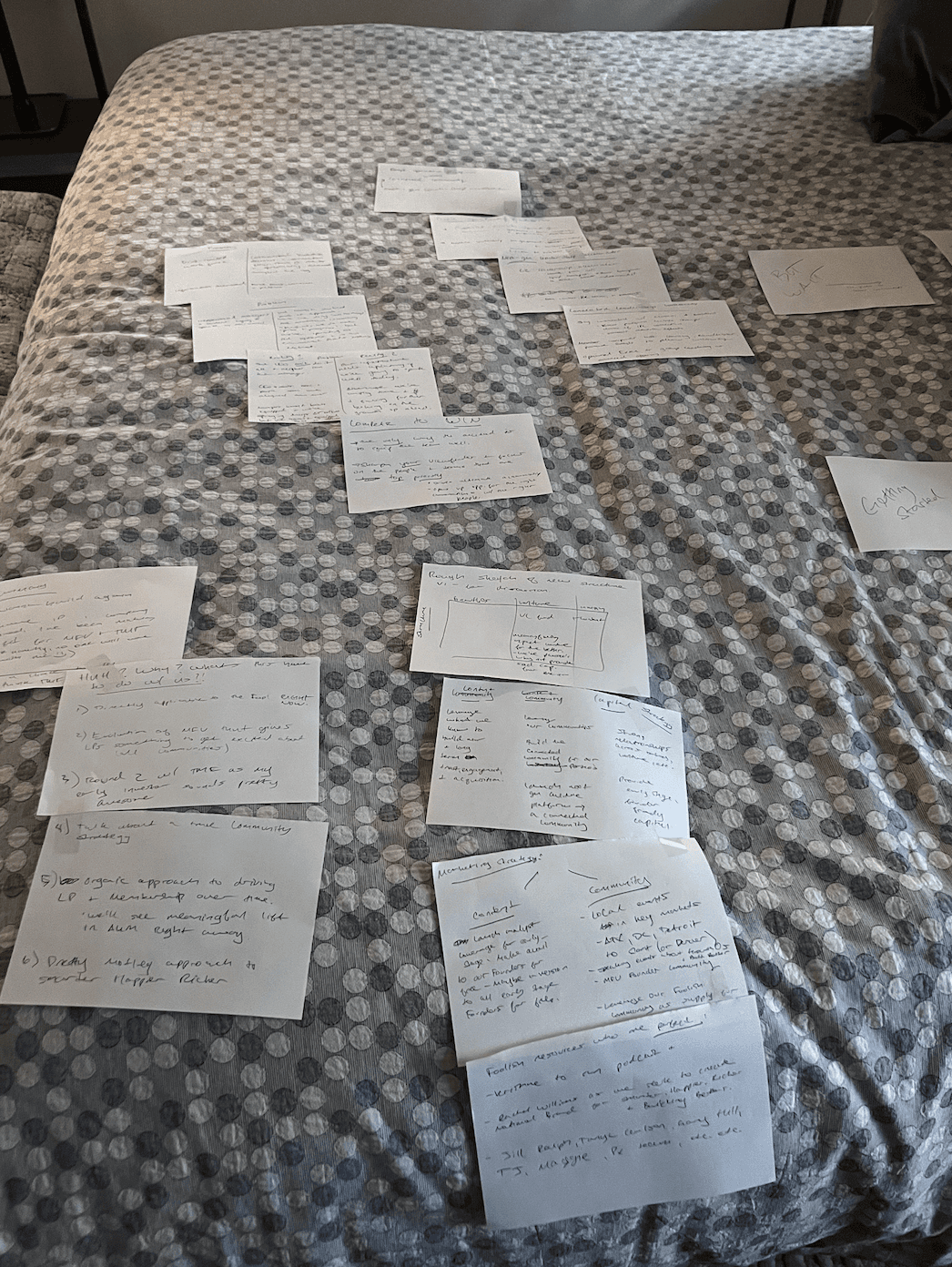
It’s nice to finally be able to talk about Faana in a way that feels understandable, after so many years of quietly building. More than that, it seemed everyone wanted to know details I wasn’t ready to talk about, so we didn’t.
Building something like this - or any business that’s worth something - is strange. It is somehow the loneliest and most exhilarating experience of your life - every single time, at least for me.
I lose track of time when I’m building and designing, focusing on value with the customer and obsessing over the details that materially matter - if I’m selling whatever it is I’m building to the right people. I disappear into the act of creation, and it’s so easy to lose track of a few minutes only to realize I’ve been immersed in something for many, many hours. Days, even.
A few minutes can turn into many hours. Days blur into each other. Entire seasons seem to pass and here I am, deep in the work.
In moments of exhaustion, frustration, or fear, I make the mistake of questioning everything about the time spent - even though I know that interrogating the past is a fool’s errand. Fortunately, I always remember a fundamental truth: high-quality output requires incredible intention in how we design our time. It takes thousands of "at-bats" just to land the single home run that knocks it out of the park. Peak performance demands a currency far more valuable than mere hours.
Rushing Blocks Consciousness.
Everyone is rushing everyone else. In 2026, frantic urgency is en vogue because leaders feel they are losing control of the hours they have left to spend.
“Get to the point already.” It seems like an innocent phrase, perhaps a sharp bit of corporate shorthand used to manage a long-winded colleague, but it is a silent killer of creativity. It carries the distinct risk of crushing the spirit of the person carrying the message, permanently disrupting the flow of critical insight that was on its way to you.
What does it actually mean to "get into flow"?
For an individual, finding flow sits at the absolute intersection of neuroscience, cognitive psychology, and leadership fitness. Flow is not just "being focused." It is a temporary, highly coordinated state where multiple cognitive systems synchronize around a single objective.
When that synchronization is shattered by a sudden interruption, the tax is not just lost time. The brain has to rebuild an entire operating environment from scratch.
The cognitive science of rebounding into flow proves why true immersion takes much longer than we think. Recovery is never a clean sequence of interruption → resume. Instead, the brain must navigate a heavy, multi-layered transition:
Interruption → Attention Residue → Context Rebuilding → Momentum → Immersion → Flow
To get back to peak efficiency, the brain is forced to completely reload:
Task Context: What was I just doing?
Mental Models: How was I conceptualizing this problem?
Emotional State: Where was my baseline motivation?
Momentum: In what direction was my creative energy moving?
The Hidden Cost of Internal Vigilance
Beyond the cognitive load, disruption has a corrosive emotional impact on a team. When stress or fear enter the operational equation, the human brain undergoes a systemic shift: it moves out of explore/build mode and locks into protect/defend mode. Creation and vigilance cannot coexist. If your company culture carries unresolved tension, relational conflict, or systemic worry as an everyday feature of its operating system, a massive portion of your team’s cognitive bandwidth remains permanently dedicated to scanning for threats.
This is not a character flaw. It is not a case of "people just don't want to work hard anymore." It is a design failure. When leaders mistake a survival response for a lack of ambition, they throw superficial solutions at the wrong problem, driving engagement further into the ground.
While organizations rarely track the financial cost of chronic disruption, the price is paid daily. It is stamped all over missed milestones, constantly restated objectives, and evaporated opportunities, leaving executive teams comforting themselves with the same tired narrative: “Maybe we’ll catch the next one.”
The Pressure to Pause
Patience is a premium strategic virtue, yet most modern teams lack the capacity to create the conditions required for success to occur. Even with explicit executive support and approved budgets, the barrier to innovation often runs much deeper.
Ask yourself honestly: Do you have the leadership capacity across your organization to allow a raw, creative idea to live long enough to fight through creative friction? Or does the system kill the seed before it can be polished into a breakthrough?
Every team is under immense pressure right now, but our capacity to hit pause and think deeply depends entirely on the psychological makeup of those in leadership positions. Under chronic stress, executives instinctively eliminate the pause, stripping away the breathing room thinkers need to contribute. If we think people are going home thinking of our company and the way the company can be more successful, you have to give them a reason to care. Care today costs a premium - make sure you’re paying it.
Speaking from personal experience, I have worked hard to bring back the pause so I stop interrupting people mid-sentence, a condition that became a critical feature of working with investors and very busy people who never have time to engage well.
I didn't operate this way pre-COVID, but the compounding uncertainty of the years since has nurtured and reinforced a frantic pace, and the quality of the company I keep impacts this greatly. This is not a one and done thing, but something I look at regularly, forcing myself to ask the hard questions, and holding myself accountable to the often uncomfortable truth. These are the ones on regular repeat.
Where am I killing the creative potential of those around me?
Where am I intentionally architecting innovation?
What habits are on autopilot that are worth looking at so that I may ask, “how is this serving me today (versus how it might have served me before)?”
Am I around people who want to innovate, crave the change that is required for good growth, and are willing and able to commit to it?
I would love to know your questions - what you ask yourself - to be a better version of you, each day.
Author:
Autumn Manning, Founder of Faana
More From
The Standard

Community, Leadership
The opportunity to build a life I chose, work on a company I chose, and to express my passion creatively through entrepreneurship - well, this is truly the American Dream.

Labeling frontline execution friction as middle-management incompetence is a failure to diagnose an isolated boardroom ecosystem that demands deep, adaptive human leadership while providing only the rigid, clinical tools of compliance.
Adaptive Capacity
The business world has been absolutely obsessed with artificial intelligence since it shattered the status quo in 2022. Every single boardroom is discussing it, investors are funding it to the tune of billions, and founders and CEOs everywhere are losing sleep over it.
Community Fitness
What is a community if not a system of support? To be in community means to connect - the deep and real essence of what it means to be human.